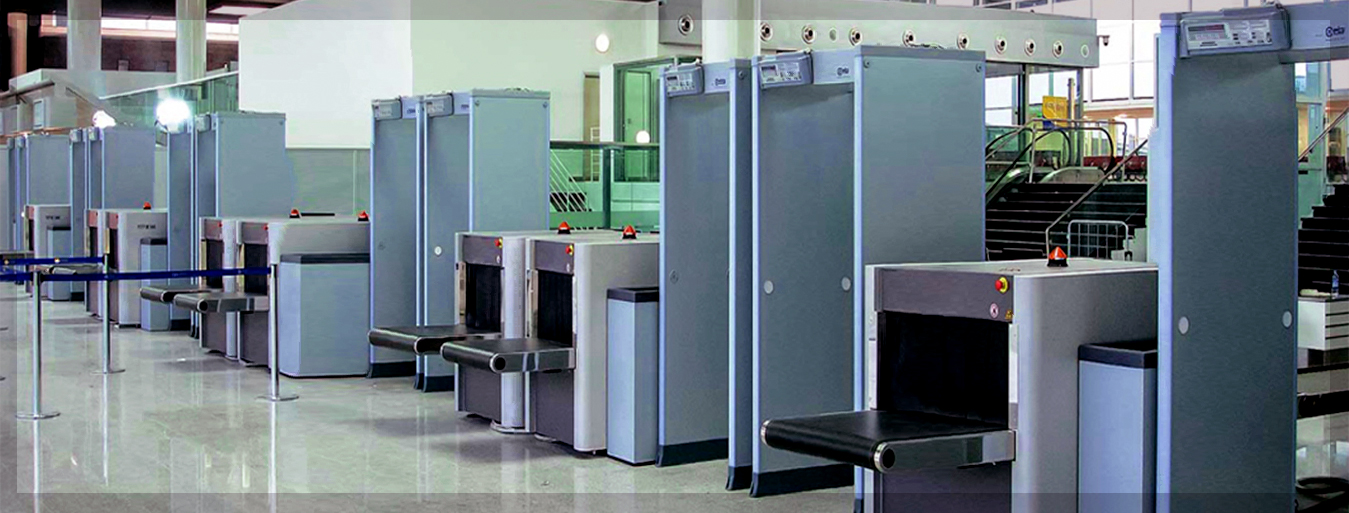
DFMD full form
DFMD stands for Door Frame Metal Detector. In Hindi it is written as डोर फ्रेम मेटल डिटेक्टर. It is the walk-through archway used to screen people for metal objects at airports, railway stations, government buildings, shopping malls, stadiums, factories and event venues. A person walks through the frame; if metal is carried, the unit raises an audible and visual alarm.
The term is sometimes written DMFD or “door type metal detector”. These refer to the same equipment. A hand held metal detector is the companion device used for the follow-up search once a DFMD flags someone.
What is a door frame metal detector and how does it work?
Those who visited airports, train stations, government offices, shopping malls, theatres, and events would have passed through this security equipment to prove they were not carrying any metal objects. This security device is known as a “Door Frame Metal Detector.” This security technology enables security officers to inspect individuals entering a building for metal or potentially dangerous objects. Metal Detectors, like baggage scanners and CCTV cameras, are safe and effective.
Metal detectors for door frames employ pulse induction technology. This Pulse Induction method transmits short, strong current pulses across the wire coil. The impulse produces a brief magnetic field. When a particle of metal passes through this magnetic field, a reflected magnetic field will emerge, and this reflected magnetic field will interact with the reception coil, causing the door frame metal detector to sound an alert. This operation will take a few microseconds to complete. This current is known as reflected pulse and has a duration of around 30 microseconds.
Typically, PI-based metal detectors emit 100 pulses per second, however this figure can range from 25 pulses to over 1,000 pulses per second depending on the brand and type. Door frame metal detectors generate magnetic fields that permeate the whole interior space of the metal detector. If a person passes through the metal detector and the alarm sounds, airport security is notified that he or she may be carrying a dangerous metal-based weapon, such as a knife or a gun, and directed to conduct a more thorough search.
The most advanced metal detectors have numerous zones that not only sound an alarm but can also discover buried metal objects. The multi-zone door frame metal detectors contain multiple magnetic coils that generate a separate detecting zone. They can identify many objects simultaneously and reveal all hiding locations. Latest door frame metal detectors are available in up to 33 zones. The alarm lights on the side of the metal detector make it much easier for security officers to locate anything that have been concealed.
The most up-to-date door frame metal detectors have several detection zone detectors that allow them to examine the metal location that triggered the alert. This version has proven to be a secure and efficient way to maintain security.
Types of DFMD: single zone and multi-zone
There are two different types of door frame metal detectors (DFMDs) exist:
- Single zone DFMD
- Multi-zone DFMD provide multi-zone detection
A Multi-zone DFMD (door frame metal detectors) will determine if the target is on the left or right side of the individual. If a person walks through the DFMD (door frame metal detectors) while carrying a concealed weapon around their ankles, both the single and multi zone DFMD (door frame metal detectors) will detect the target. Multi-zone DFMD differs from Single-zone DFMD in that it may determine the target’s location on either the left or right side of the individual.
Multi-zone technology distinguishes small pistols from innocuous objects such as keys and coins.
Multi-zone The Continuous Wave Multiple Sensor Measurement Technique is favoured by DFMD over the Pulse Induction approach. This enhances screening efficiency and reduces operating expenses. Multiple zones of detection enable the precise localization of concealed weapons.
A display indicates whether a weapon is on the left, right, or centre of the individual being screened, as well as whether it is at ankle, knee, waist, chest, or head height. If many weapons are carried, each is detected and its location is displayed. During the subsequent manual search, security professionals can immediately zero in on the offending object or objects (s.).
Horizontal multiple zone technology is distinguished by its ability to effectively distinguish between small pistols and innocuous things. Those who are being screened can pass past the detector without having to empty their pockets of the usual quantity of keys and coins. Using a single operating mode, weapons made from steel, various grades of stainless steel, aluminium, zinc alloys, and mixed alloys are detected.
The system provides superior resistance to electrical interference, hence eliminating false alarms that impede traffic flow. Additionally, the technology is continuously active, preventing weapons or contraband from being transferred, slid, or thrown through the detector undetected.
Main parts of a DFMD
A door frame metal detector is built from a small number of components:
- Side panels (pillars): the two vertical columns the person walks between. These house the coils.
- Transmitter coil: generates the magnetic field across the opening.
- Receiver coil: picks up the disturbance in that field caused by metal.
- Top beam (header): joins the two panels and usually carries the control unit.
- Control panel: sets sensitivity, operating programme and zone configuration.
- Display and zone indicators: LED bars down the sides that show the height and side at which metal was detected.
- Alarm unit: audible buzzer plus visual indication.
- Base frame: the floor-mounted feet that hold the panels stable and square.
- Power supply: mains input, commonly with a battery backup option.
- Counters: most units count how many people passed and how many alarms were raised.
डोर फ्रेम मेटल डिटेक्टर (DFMD) क्या है?
DFMD का फुल फॉर्म Door Frame Metal Detector है, जिसे हिंदी में डोर फ्रेम मेटल डिटेक्टर कहा जाता है। यह एक वॉक-थ्रू गेट होता है जिससे होकर व्यक्ति गुजरता है, और यदि वह कोई धातु की वस्तु साथ ले जा रहा हो तो मशीन अलार्म बजा देती है।
इसका उपयोग हवाई अड्डों, रेलवे स्टेशनों, सरकारी भवनों, मॉल, स्टेडियम और फैक्ट्रियों में सुरक्षा जाँच के लिए किया जाता है। यह चुंबकीय क्षेत्र (magnetic field) बनाकर काम करता है — जब कोई धातु उस क्षेत्र से गुजरती है, तो रिसीवर कॉइल उसे पहचान लेता है।
DFMD मुख्यतः दो प्रकार के होते हैं: सिंगल ज़ोन और मल्टी ज़ोन। मल्टी ज़ोन मशीन यह भी बताती है कि धातु शरीर के किस हिस्से में और किस तरफ है।
Frequently asked questions
What is the full form of DFMD?
DFMD stands for Door Frame Metal Detector.
What is the working principle of a DFMD?
Most units use pulse induction. Short, strong current pulses are sent through a transmitter coil, each producing a brief magnetic field. Metal passing through that field produces a reflected field, which the receiver coil picks up and converts into an alarm. The whole cycle takes microseconds.
How many zones does a door frame metal detector have?
Single-zone units report only that metal is present. Multi-zone units divide the opening into separate detection zones and report the height and side, so the manual search can go straight to the right place. Current designs are available in up to 33 zones.
Will a DFMD alarm on keys and coins?
Sensitivity is adjustable, and multi-zone units using continuous-wave sensing are better at separating small personal items from weapon-sized objects, so people can usually walk through without emptying their pockets.
Where are door frame metal detectors used?
Airports, railway and metro stations, government and court buildings, shopping malls, cinemas, stadiums, places of worship, examination centres, factories and large events.
Door frame metal detectors from Houston Systems
Houston Systems manufactures door frame metal detectors in India and supplies them to customers in India and overseas. See the door frame metal detector range, the hand held metal detector used alongside it, and our baggage scanners for screening bags at the same checkpoint.
Contact us for specifications, pricing or a site recommendation.