A security barrier controls who gets through an entrance, and on what terms. Which type you need depends on what you are stopping — vehicles or people — and how hard you need to stop it. This guide covers the main types of security barrier gates, what each is suited to, and how to choose between them.
The main types of security barrier gate
- Boom barriers — vehicle traffic control
- Bollards — vehicle access control and impact protection
- Road blockers and tyre killers — high-security vehicle denial
- Tripod turnstiles — pedestrian counting and access
- Flap barriers — fast pedestrian throughput
- Full height turnstiles — unmanned pedestrian perimeters
- Sliding and swing gate operators — automating existing gates
1. Boom barriers
A horizontal arm that raises and lowers across a lane. Boom barriers are the standard choice for managing vehicle traffic at car parks, toll plazas, factory gates, apartment complexes and office entrances. They regulate flow and enforce authorisation; they are not designed to stop a determined vehicle.
The arm is raised by a pass, card, ticket, remote, number-plate recognition or an operator. Specify by lane width and by how many vehicles pass in the busiest hour — cycle speed matters far more than any other figure once traffic is heavy.
See our automatic boom barriers.
2. Bollards
Vertical posts set into the ground, either fixed or retractable. Rising bollards drop below the surface to let authorised vehicles pass and rise again to block the lane. They suit pedestrian zones, building forecourts and any place where the barrier must disappear when not in use.
Unlike a boom arm, a bollard can be built to physically arrest a vehicle, which is why they are used where vehicle-borne threat is a concern rather than just unauthorised parking.
See our bollards.
3. Road blockers and tyre killers
The high-security end of vehicle control. A road blocker is a heavy plate that rises from the road surface to stop a vehicle outright. A tyre killer (also called a spike barrier or tyre buster) presents angled spikes that destroy the tyres of a vehicle travelling the wrong way, while allowing free passage in the permitted direction.
These are specified for military sites, embassies, airports, data centres and critical infrastructure, usually behind a boom barrier that handles the routine traffic.
See our perimeter protection systems.
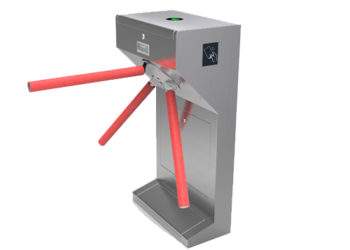
4. Tripod turnstiles
Three rotating arms at waist height that release one rotation per valid credential, so exactly one person passes at a time. This is what makes them useful: they enforce one-person-one-entry and give an accurate count of who went through.
Tripod turnstiles are common in offices, factories, gyms, metro stations and campuses, usually tied to a card, biometric or QR reader. They are a controlled gate, not a physical deterrent — an anti-panic mechanism releases the arms for evacuation.
See our tripod turnstiles.
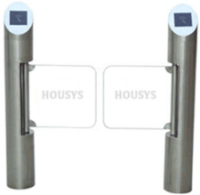
5. Flap barriers
Retracting panels that open and close across a walkway. Flap barriers move people through faster than a tripod turnstile, which is why they are chosen for building lobbies and transit entrances where queues build at peak times.
Wide-lane versions take wheelchairs, luggage and trolleys, so a site that needs step-free access usually pairs one wide lane with several standard lanes. Options commonly include low and high speed units, card-operated, biometric, and remote-controlled models.
See our flap barrier gates.
6. Full height turnstiles
A floor-to-ceiling rotating cage. Because it cannot be climbed over or crawled under, it is the right choice for an unmanned perimeter — substations, depots, stadium gates, industrial boundaries — where there is no guard present to challenge anyone.
See our full height turnstiles.
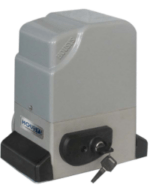
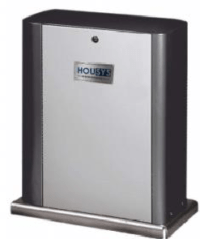
7. Sliding and swing gate operators
Where a site already has a gate, an operator automates it rather than replacing it. Sliding operators suit wide openings and sloping ground; swing operators suit lighter gates with room to arc open. Both integrate with the same access control as the barriers above.
See our sliding gate operators and swing gate operators.
How to choose
Three questions settle most specifications:
- Vehicles or people? Vehicles point to boom barriers, bollards and road blockers. People point to turnstiles and flap barriers.
- Control or denial? If the job is to manage authorised traffic, a boom barrier or turnstile is enough. If the job is to physically stop an unauthorised vehicle, you need bollards or a road blocker.
- What is the peak-hour volume? This decides cycle speed and how many lanes you need, and it is the figure most often underestimated.
Sites frequently combine types: a boom barrier for routine vehicle entry with bollards behind it, or flap barriers for staff with a full height turnstile on the unmanned perimeter gate.
Frequently asked questions
What are the main types of security barriers?
Boom barriers, bollards, road blockers and tyre killers for vehicles; tripod turnstiles, flap barriers and full height turnstiles for pedestrians. Sliding and swing gate operators automate existing gates.
What is the difference between a boom barrier and a bollard?
A boom barrier regulates authorised traffic with a horizontal arm. A bollard is a vertical post that can be built to physically stop a vehicle, and it retracts out of sight when not needed.
Which barrier is best for pedestrian entry?
A tripod turnstile where you need one-person-at-a-time control and accurate counting; a flap barrier where throughput and step-free access matter more; a full height turnstile where no guard is present.
Can a boom barrier stop a vehicle?
No. A boom barrier controls and deters, but the arm will not arrest a vehicle driven through it. Where that is the requirement, use bollards or a road blocker.
Houston Systems manufactures all of the above in India and supplies them in India and overseas. Contact our team with your lane widths and peak-hour traffic and we can recommend a configuration.